
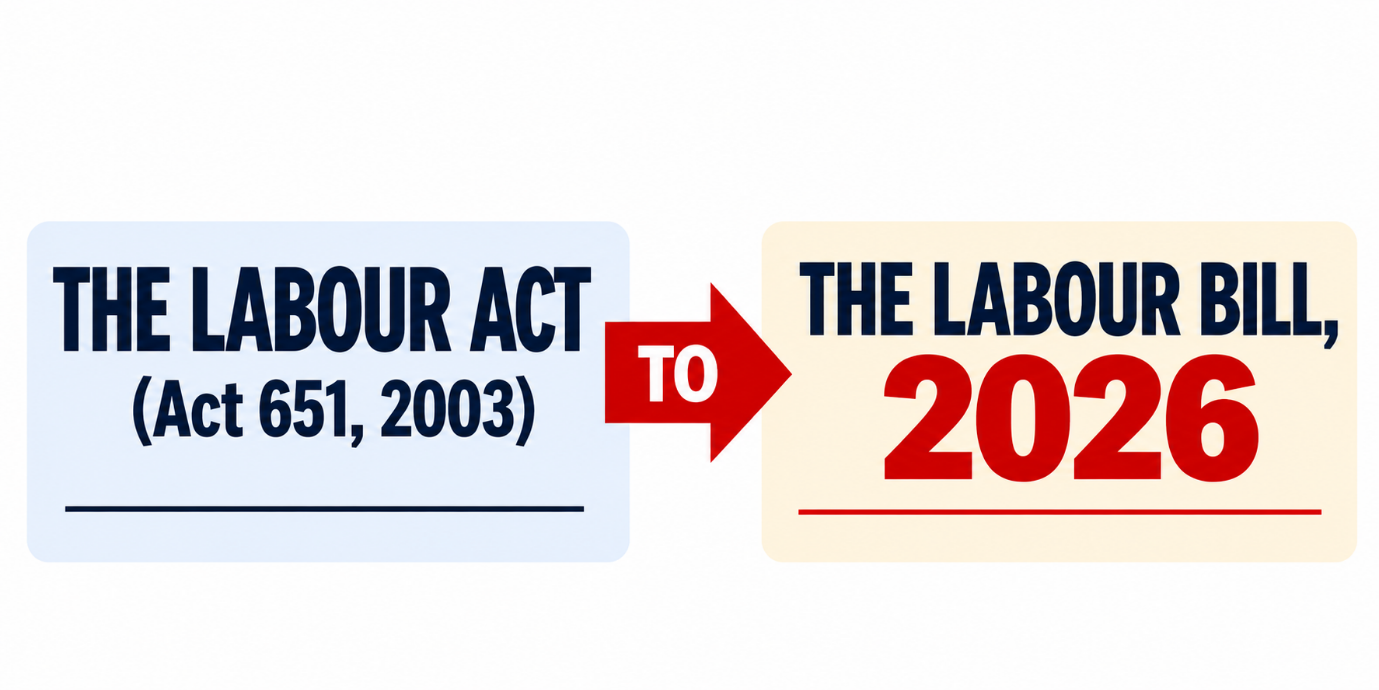
Ghana is considering a major reform of its labour law, with the proposed Labour Bill, 2026 seeking to replace the Labour Act, 2003 (Act 651), and consolidate aspects of the country’s employment and industrial relations framework. The draft, which is still subject to stakeholder consideration, presents an important opportunity to examine whether Ghana’s labour laws adequately reflect the realities of today’s workplace and the demands of a changing economy.
For workers, employers, trade unions and human resource practitioners, the question is not simply whether Ghana needs a new Labour Act. It is whether the proposed law will close existing gaps, improve the enforcement of employment rights, clarify the responsibilities of the parties and create a more predictable framework for resolving workplace disputes.
An examination of the draft reveals that it goes beyond a straightforward revision of Act 651. It proposes new regulatory arrangements, introduces provisions addressing emerging forms of work, expands certain employment protections and restructures parts of the machinery responsible for labour administration and dispute resolution.
However, the Bill must be assessed carefully. Some provisions represent proposed new protections, others strengthen or reorganise existing arrangements, while some introduce policy choices that could generate substantial debate during stakeholder consultations.
The Labour News’ analysis is based on the draft Labour Bill, 2026 a copy of which was intercepted. The proposals discussed below should not be treated as existing law. The final position will depend on the outcome of consultation, revision and the parliamentary process.
Beyond Act 651: Why the proposed reform matters
The Labour Act, 2003 (Act 651) has provided the principal legislative framework for employment and industrial relations in Ghana for more than two decades. It addresses employment contracts, working hours, leave, remuneration, termination, redundancy, trade union activities, collective bargaining and the settlement of industrial disputes.
Yet the world of work has changed considerably since the Act was enacted. Digital platforms now connect workers to customers, recruitment increasingly crosses national borders, workplace harassment is receiving greater attention, and employers face growing expectations concerning occupational safety, equality and responsible employment practices.
The challenge is to ensure that the law remains relevant without creating unnecessary uncertainty for employers or weakening the rights of workers.
The 2026 draft seeks to respond to several of these developments. It proposes a National Labour Authority, more detailed regulation of platform services, an expanded framework for workplace violence and harassment, new leave entitlements and a revised structure for occupational injury compensation. It also contains extensive provisions on collective bargaining, tripartite engagement, employment coordination and the settlement of industrial disputes.
These changes suggest an attempt to modernise the legal framework. But modernisation should not be measured by the number of new sections in a Bill. Its real value will depend on whether the proposed provisions are clear, enforceable, properly funded and capable of improving workplace relations.
A new regulatory framework for labour administration
One of the most significant institutional changes is the proposal to establish a National Labour Authority.
Under Act 651, labour administration includes functions relating to labour inspection, employment services and the National Labour Commission, which plays an important role in industrial dispute settlement. The new draft proposes a more extensive administrative structure, with the National Labour Authority responsible for regulatory and enforcement functions while a National Labour Commission continues to deal with dispute resolution and adjudication.
The proposed Authority would have responsibilities that include labour inspection, employment services, workplace compliance, employment data, guidance to employers and workers, and the implementation of labour policies.
The proposed separation between regulatory administration and dispute resolution could allow greater specialisation. An institution focused on inspection and compliance may be better positioned to identify violations, while a separate commission can concentrate on resolving disputes and applying the law.
However, the reform raises important questions. How will the Authority and the Commission coordinate their work? Which institution will receive and investigate particular complaints? How will enforcement decisions be reviewed? What safeguards will prevent overlapping mandates, administrative delays or inconsistent interpretations of the law?
The creation of a new institution does not automatically strengthen enforcement. The Authority will require trained labour inspectors, adequate funding, effective regional coverage, reliable information systems and clear procedures for dealing with complaints.
The success of the proposed arrangement will therefore depend on more than its statutory mandate. It will depend on whether the institutions can deliver timely, consistent and credible outcomes.
Digital platform work: Bringing emerging employment arrangements into the law
One of the draft’s most notable features is its proposed regulation of platform services.
Act 651 does not contain the same detailed framework for licensing and regulating digital labour platforms. The 2026 draft proposes requirements for platform operators, including licensing, contracts of engagement, the provision of information about registered persons and certain social security and tax-related arrangements.
The draft also provides for the right of platform workers to form or join a trade union and proposes a ceiling on the fee payable for operating on a platform.
These provisions are important because digital platforms have changed how many people obtain work and earn income. Drivers, delivery workers and other service providers may rely on platforms for access to customers, yet their contractual arrangements can differ from conventional employment relationships.
The central issue is whether the proposed framework will provide meaningful protection while recognising the different ways platform work is organised.
The Bill should make clear how the rights and obligations of platform operators and workers will be determined, who is responsible for social security contributions and tax deductions, and how disputes over payment, access to work or contractual termination will be resolved.
The proposed fee ceiling also deserves careful examination. Its practical effect will depend on how the fee is calculated, which charges are included and how compliance will be monitored.
The opportunity is significant: Ghana could develop a clearer framework for work in the digital economy. But the final legislation must avoid creating uncertainty over the legal status of workers or leaving important protections dependent on future administrative decisions.
Written contracts and the protection of workers
The draft also proposes a change to the threshold for written employment contracts.
Under section 12 of Act 651, employment lasting six months or more is generally required to be secured by a written contract. Section 49 of the draft Bill proposes a written contract for employment lasting two months or more.
If retained, this change could improve documentation for workers whose employment arrangements are too short to fall within the existing six-month threshold but long enough for disputes over wages, duties, working hours or termination to arise.
A written contract helps both parties understand their obligations. It can identify the agreed remuneration, working arrangements, leave entitlements, notice periods and other conditions of service. It also provides evidence when a disagreement arises.
The proposed change would, however, require employers to review their recruitment and onboarding processes, particularly businesses that rely on fixed-term or short-duration engagements.
The key implementation question is whether the requirement will be accompanied by accessible guidance and practical compliance arrangements for smaller employers.
The objective should be to improve transparency without making it unnecessarily difficult for businesses to engage workers lawfully.
Family leave: A proposed expansion of employment protection
The proposed provisions on family-related leave are among the changes likely to attract public attention.
Act 651 provides a minimum maternity leave entitlement of 12 weeks. Section 98 of the draft proposes a minimum of 16 weeks, together with provisions dealing with certain extensions and circumstances involving the loss of a baby.
The draft also introduces paternity leave under section 72, providing for at least five days subject to the stated eligibility requirements. Section 73 proposes compassionate leave of at least five days in specified circumstances involving family bereavement or a medical emergency.
These proposals would make family-related leave more explicit in the general statutory framework.
Longer maternity leave could provide additional time for recovery and infant care. Paternity leave would formally recognise the role of fathers in supporting mothers and caring for newborn children. Compassionate leave could provide workers with a defined entitlement to respond to serious family circumstances.
Nevertheless, the details matter. Stakeholders should examine the eligibility conditions, the circumstances in which leave may be taken, the relationship between statutory minimums and collective agreements, and the treatment of workers in temporary or casual employment.
The restriction on repeated paternity leave within a 24-month period, for example, raises questions about how the provision would apply to fathers who have more than one child within that period.
The final wording should be clear enough to guide employers and employees without generating avoidable disputes over entitlement.
Workplace violence and harassment: From recognition to prevention
The draft proposes a more comprehensive framework for addressing workplace violence and harassment under sections 152–156.
The provisions include workplace policies, prevention measures, complaint and investigation procedures, confidentiality, protection against victimisation and remedies for affected workers.
This is a significant area for employment policy because workplace misconduct can undermine dignity, safety, productivity and trust. Workers may be reluctant to report harassment if they fear retaliation, damage to their careers or the mishandling of confidential information.
A statutory requirement for employers to establish appropriate policies and reporting mechanisms could help make prevention and accountability part of ordinary workplace governance.
However, the legislation should provide sufficient clarity about the responsibilities of employers, the handling of complaints, the protection of complainants and witnesses, and the fairness of investigations for all parties.
The law should also distinguish between the duty to investigate a complaint fairly and the determination of whether misconduct has occurred. Confidentiality should protect those involved without preventing lawful accountability.
For employers, the proposed framework would reinforce the importance of workplace policies, staff education, reporting channels and appropriate disciplinary procedures. For workers, it could provide a clearer route for seeking redress.
Its practical effect will depend on whether institutions comply with the requirements and whether workers can access remedies without fear of retaliation.
Redundancy and termination: Greater clarity, but important questions remain
Termination of employment and redundancy are areas where legal uncertainty can have serious consequences for workers and employers.
The draft addresses redundancy in section 109 and termination in sections 110–119. It provides for consultation and notification in redundancy situations and sets out grounds for termination, notice requirements, payments due at termination and remedies for unfair termination.
The draft also proposes a more specific compensation framework for unfair termination under section 116. The proposed formula takes account of the worker’s age and the period the worker may require to secure other employment or reach compulsory retirement, subject to the terms and limits set out in the provision.
This proposal deserves particularly close scrutiny.
A clearer compensation framework could make outcomes more predictable and assist the parties in assessing the consequences of unlawful termination. But a formula that differentiates compensation by age also raises questions about fairness, proportionality and the practical application of the criteria.
Stakeholders should consider whether the formula adequately accounts for the circumstances of the individual case, including the nature of the violation, the worker’s loss and the availability of other employment. They should also examine how the proposed framework interacts with the Commission’s remedial powers and existing contractual or collective-agreement rights.
The final provision should balance predictability with fairness. It should not create a system that encourages unlawful termination, produces arbitrary differences between workers or makes remedies disproportionate to the circumstances.
For employers, the practical message is that performance management, discipline, documentation and termination procedures must be handled with care. For workers, the availability of remedies is meaningful only if complaints can be heard promptly and decisions can be enforced.
Occupational injury compensation: Consolidating the legal framework
The Bill proposes to incorporate occupational injury and disease compensation provisions into the new Labour Act. It also proposes repealing the Workmen’s Compensation Act, 1987 (P.N.D.C.L. 187).
This would be a consolidation and reform of an existing area of law, not the introduction of workers’ compensation for the first time.
The draft addresses compensation for occupational injuries and diseases, liability, medical expenses, dependants’ entitlements and compensation for different forms of incapacity.
The potential benefit is a more integrated statutory framework linking employment regulation, occupational safety and compensation.
But consolidation is not enough on its own. The final law must be assessed against the adequacy of compensation, the procedures for reporting and assessing injuries, the treatment of occupational diseases, the protection of dependants and the time required to resolve claims.
The transition from the existing legislation must also be clear. Workers with pending claims should not lose protection because the legal framework has changed, and employers must understand their continuing obligations.
Occupational injury compensation is especially important in sectors where workers face significant physical risks. A modern framework must provide an effective route to compensation while encouraging employers to prevent accidents and maintain safe working conditions.
Overtime, working hours and the cost of compliance
The draft proposes a minimum overtime rate of 25 per cent of a worker’s daily wage under section 76. It also provides for unpaid overtime in specified exceptional circumstances under section 79, including accidents, force majeure and urgent work involving machinery or plant that threatens human life or the existence of an undertaking.
Act 651 requires overtime rates to be fixed but does not prescribe the same minimum formula.
The proposed minimum could improve predictability, but the rate and its method of calculation will require careful review. Stakeholders should establish how the daily wage is to be determined, how the minimum applies to additional hours, and how the provision interacts with more favourable collective agreements.
The exception permitting unpaid overtime also requires clear safeguards. It should not become a routine means of avoiding overtime payments or extending working hours without adequate protection.
The Bill should make it clear that exceptional circumstances are genuinely exceptional and that employers must be able to justify reliance on the provision.
For employers, these changes may require adjustments to payroll systems, timekeeping procedures, employment contracts and overtime policies. For workers, the main concern is whether the law will provide a clear and enforceable minimum standard.
Labour clearance and enforcement: Can the proposed system work?
The draft proposes a Labour Clearance Certificate for persons bidding for certain government-funded contracts. It also introduces more structured employment-data reporting and administrative penalties for specified failures to comply.
These mechanisms could make labour compliance more visible and create incentives for employers to meet their legal obligations.
However, the design of enforcement mechanisms is critical. The law should establish transparent criteria for obtaining a certificate, reasonable processing times, clear fees where applicable, and a fair process for reviewing decisions.
Administrative penalties should be proportionate to the nature and seriousness of the breach. Employers should also have an opportunity to correct inadvertent errors where the law permits, rather than face disproportionate consequences for minor or technical failures.
Employment-data reporting could improve labour-market planning and help government understand job creation, workforce composition and employment trends. But it must be accompanied by clear data requirements, appropriate confidentiality protections and practical guidance for employers.
A compliance system should encourage lawful employment and correct violations. It should not become an unpredictable administrative burden that discourages business activity without delivering better protection for workers.
Collective bargaining and industrial relations: Will the new framework prevent disputes?
Industrial relations remain central to the success of any Labour Act.
The draft contains extensive provisions on trade union rights, collective bargaining, collective bargaining certificates, negotiating committees, the National Tripartite Committee, the National Labour Commission and the settlement of industrial disputes.
It retains a provision prohibiting a strike or lockout while negotiation, mediation or arbitration proceedings are in progress. The draft’s industrial-dispute framework also addresses negotiation, mediation, arbitration and essential services.
These provisions are important because industrial peace depends not simply on the existence of a law, but on the confidence of workers and employers that the dispute-resolution process is fair, timely and effective.
A prohibition on industrial action during specified proceedings must be read alongside the procedural rules governing when those proceedings begin and end. Stakeholders should examine whether the draft makes these stages sufficiently clear and whether the parties have a realistic opportunity to resolve disputes within the prescribed timelines.
A law that restricts industrial action without providing a credible route to settlement risks deepening frustration. Equally, a framework that leaves disputes unresolved for extended periods can create uncertainty for employers, workers and the wider economy.
The objective should be a balanced system that protects legitimate labour rights while promoting timely negotiation, mediation and arbitration.

The proposed National Tripartite Committee and National Employment Coordination Committee could also strengthen dialogue and employment policy coordination. Their effectiveness will depend on meaningful participation, reliable information and follow-through on agreed decisions.
For organised labour, the consultation process provides an opportunity to scrutinise provisions affecting collective bargaining, union activity and industrial action. Employers should examine the implications for compliance, productivity and dispute prevention. Government must ensure that the institutions responsible for implementation are properly equipped to carry out their mandates.
CBC Renewal: A new compliance safeguard or a potential pressure point for Trade Unions?
One provision likely to attract close scrutiny from organised labour is the proposed renewal of Collective Bargaining Certificates (CBCs). Under Sections 226(14) and 227 of the draft Labour Bill, 2026, a CBC would be valid for five years and subject to renewal. An application for renewal must be submitted in writing to the Authority and accompanied by the trade union’s audited financial statements and the prescribed fee.
The provision introduces a formal renewal requirement that trade unions will need to consider carefully. While periodic renewal may be defended as a mechanism for maintaining accurate records, verifying compliance and ensuring accountability, it also raises questions about the discretion of the authority responsible for granting renewals and the safeguards available to unions whose applications are delayed or rejected.
In conversations with some trade union General Secretaries, concerns have emerged that the renewal process could potentially be used to frustrate unions whose leadership is perceived as critical of, or insufficiently supportive of, the government of the day. These concerns should not be interpreted as evidence that the government intends to use the proposed provision for political purposes. However, they highlight a governance risk that deserves serious attention during stakeholder consultations on the Bill.
The central issue is whether the renewal process will operate transparently, consistently and independently of political considerations. If renewal decisions are based on clear, objective and publicly known criteria, applied equally to all qualifying unions, the process could serve a legitimate regulatory purpose. If, however, the criteria are unclear, decisions are subject to excessive discretion, or applications can be delayed without adequate explanation, the process could create uncertainty for unions and potentially expose them to undue administrative pressure.
This concern is particularly significant because a Collective Bargaining Certificate is connected to a union’s ability to exercise collective bargaining rights. Any uncertainty surrounding its renewal could therefore have consequences beyond routine administration, potentially affecting a union’s capacity to represent workers and negotiate with employers. The draft provision should consequently be assessed not only as a compliance requirement but also in terms of its implications for freedom of association and effective collective bargaining.
International labour standards provide an important benchmark. Article 3 of the International Labour Organization’s Freedom of Association and Protection of the Right to Organise Convention, 1948 (Convention No. 87), recognises the right of workers’ organisations to organise their administration and activities without public-authority interference that restricts or impedes the lawful exercise of that right. The ILO’s Committee on Freedom of Association has also emphasised that public authorities should treat trade union organisations impartially, including those that criticise government policies. These principles make impartial administration and protection against politically motivated treatment important considerations in designing any renewal system.
The Bill should therefore be examined for clear renewal criteria, reasonable processing deadlines, written reasons for refusal, an effective and independent appeal mechanism, and safeguards against discriminatory or politically influenced decisions. Where a renewal application is pending, the law should also clarify how the union’s existing certificate and collective bargaining activities will be treated, so that administrative delays do not unnecessarily undermine workers’ representation.
It is equally important to distinguish between the proposed five-year renewal of a Collective Bargaining Certificate and the annual publication of information about unions holding such certificates. Section 231 provides for the Authority to publish the relevant list within six months after the beginning of each year; that publication requirement is not itself an annual renewal requirement.
Ultimately, the question for organised labour is not whether trade unions should be accountable under the law. It is whether accountability will be administered through rules that are fair, predictable and subject to independent scrutiny. As the Labour Bill proceeds through consultation and the legislative process, trade unions have a legitimate basis for seeking explicit safeguards to ensure that renewal serves a regulatory purpose rather than becoming a potential instrument of administrative or political pressure.
What should organised labour, employers and government scrutinise?
The draft raises several issues that warrant detailed stakeholder consideration.
First, the legal status and protections of platform workers need to be sufficiently clear. Second, the proposed compensation framework for unfair termination should be examined for fairness, proportionality and practical application. Third, the rules on overtime and exceptional unpaid overtime require precise wording. Fourth, the relationship between the National Labour Authority and the National Labour Commission should be clearly defined. Fifth, the new leave entitlements and workplace harassment framework should be supported by clear eligibility rules, procedures and remedies.
The proposed Labour Clearance Certificate, employment-data reporting and administrative penalties also deserve attention, particularly regarding proportionality, transparency and the capacity of employers to comply.
These are not arguments for rejecting the Bill. They are questions that should be addressed while the draft remains open to review.
A sound legislative process should allow stakeholders to identify ambiguities, test the practical effects of proposed provisions and recommend amendments before the final text is settled.
The interests of workers and employers are not always identical, but both depend on clear laws, predictable procedures and credible institutions. A reform that improves clarity and enforcement can benefit both sides; a poorly drafted provision can create disputes for everyone.
A modern Labour Act must be measured by its outcomes
The Labour Bill, 2026 presents an opportunity to modernise Ghana’s labour-law framework and respond to changes in employment, technology and workplace expectations. Its proposals on platform services, family leave, workplace harassment, occupational injury compensation, labour administration and industrial relations deserve serious examination.
But the Bill should not automatically be characterised as pro-worker or pro-employer. Each provision must be assessed on its merits, including its likely impact on rights, obligations, compliance costs, dispute resolution and the wider economy.
Nor should every new provision be presented as a correction of an inconsistency in Act 651. Some proposals address areas that the existing law does not regulate in the same detail; others expand existing protections, reorganise institutions or introduce new policy choices. Those distinctions matter if the public is to understand what is genuinely changing.
The central question is whether the final law will make employment rights more enforceable, workplace obligations clearer and industrial relations more stable.
For The Labour News, the responsibility is to help workers, employers, trade unions, HR practitioners and policymakers understand the proposed changes before they become law. That requires accurate comparison, independent analysis and an honest examination of both the opportunities and the risks.
The real test of labour-law reform is not the length of the Act or the number of new provisions. It is whether the law delivers fairness, clarity, accountability and a more effective system for resolving workplace disputes.
As the draft proceeds through stakeholder consideration, the priority should be to improve the text, address its ambiguities and ensure that the final legislation reflects the practical realities of Ghana’s world of work.
Comparison: Act 651 versus the Labour Bill, 2026
|
Issue |
Existing law: Act 651 |
Proposal in the 2026 Bill |
|
Written employment contracts |
A written contract is generally required for employment lasting six months or more under section 12. |
Section 49 proposes a written contract for employment lasting two months or more. |
|
Maternity leave |
Section 57 provides at least 12 weeks. |
Section 98 proposes at least 16 weeks, with provisions for certain extensions and stillbirth or loss of a baby during the leave period. |
|
Paternity leave |
No equivalent general statutory entitlement is expressly provided in Act 651. |
Section 72 provides for at least five days, subject to eligibility requirements, including a 24-month restriction on repeat leave. |
|
Compassionate leave |
No equivalent general statutory entitlement is expressly provided in Act 651. |
Section 73 proposes at least five days for specified family bereavement or a family medical emergency. |
|
Digital platform work |
Act 651 does not contain this detailed platform-service licensing framework. |
Sections 42 and 306 address licensing and regulation of platform services and online work. |
|
Workplace violence and harassment |
Act 651 defines sexual harassment, but does not contain this same detailed, standalone policy framework. |
Sections 152–156 propose workplace policies, reporting and redress mechanisms, and protection against victimisation. |
|
Occupational injury compensation |
Workmen’s compensation is dealt with separately under P.N.D.C.L. 187. |
Sections 167–206 incorporate compensation provisions into the proposed Labour Act; section 309 proposes repealing the separate law. |
|
Labour administration |
Act 651 establishes the National Labour Commission and provides for labour inspection and employment services. |
The Bill establishes a National Labour Authority while retaining a National Labour Commission for dispute resolution and adjudication. |
|
Labour migration |
Act 651 provides the general labour framework, but not this same detailed bilateral-agreement structure. |
Sections 138–147 address overseas recruitment, foreign contract attestation and minimum safeguards in bilateral labour agreements. |
|
Employment and labour-market data |
Act 651 contains employment-service and labour-administration provisions. |
Sections 45 and 242–249 propose more structured employment reporting and national employment coordination. |
|
Unfair termination |
Act 651 provides remedies for unfair termination, including reinstatement, re-employment or compensation. |
Section 116 proposes a more specific compensation framework linked to the worker’s age and expected time to secure other employment or reach compulsory retirement. |
Special comparison: Collective Bargaining Certificate renewal
|
Issue |
Labour Act, 2003 (Act 651) and existing regulations |
Draft Labour Bill, 2026 |
|
Issuance of CBC |
Section 99 provides for the application and issuance of a certificate designating a union to negotiate for a specified class of workers. |
Section 226 provides for the proposed framework governing collective bargaining certificates. |
|
Validity period |
Section 99 of Act 651 does not itself specify the certificate's validity period. Regulation 10 of the Labour Regulations, 2007 (L.I. 1833) provides for a two-year validity period. |
Section 226(14) of the draft reportedly provides for a five-year validity period, subject to renewal. |
|
Renewal requirements |
The existing framework includes the validity period under L.I. 1833. The renewal procedure and its precise requirements should be distinguished from the provisions of Act 651 itself. |
Section 227 reportedly establishes a renewal application process, including submission of audited financial statements and payment of the prescribed fee. |
|
Verification of union representation |
Section 99(4) of Act 651 and Regulation 10 of L.I. 1833 address the determination of the appropriate union where multiple unions represent the same class of workers. |
Section 230 reportedly provides for verification relating to collective bargaining certificates. |
|
Publication and transparency |
Section 99(7) requires publication of the certificate in the Gazette. |
Section 231 reportedly provides for annual publication of the unions holding collective bargaining certificates. Annual publication should not be confused with annual renewal. |
By The Labour News



No comments yet — be the first to share your thoughts!